
On the morning of May 29th, a very different future awaited the Turkish nation. After a two-week election marathon, Erdogan left as the leader, securing five more years as the country’s leader after his 20-year rule. In this challenging election process, many alliances were formed, last-minute candidate changes occurred, and it proved that 24 hours in politics is a long time.
Parliament (Turkish Grand National Assembly)
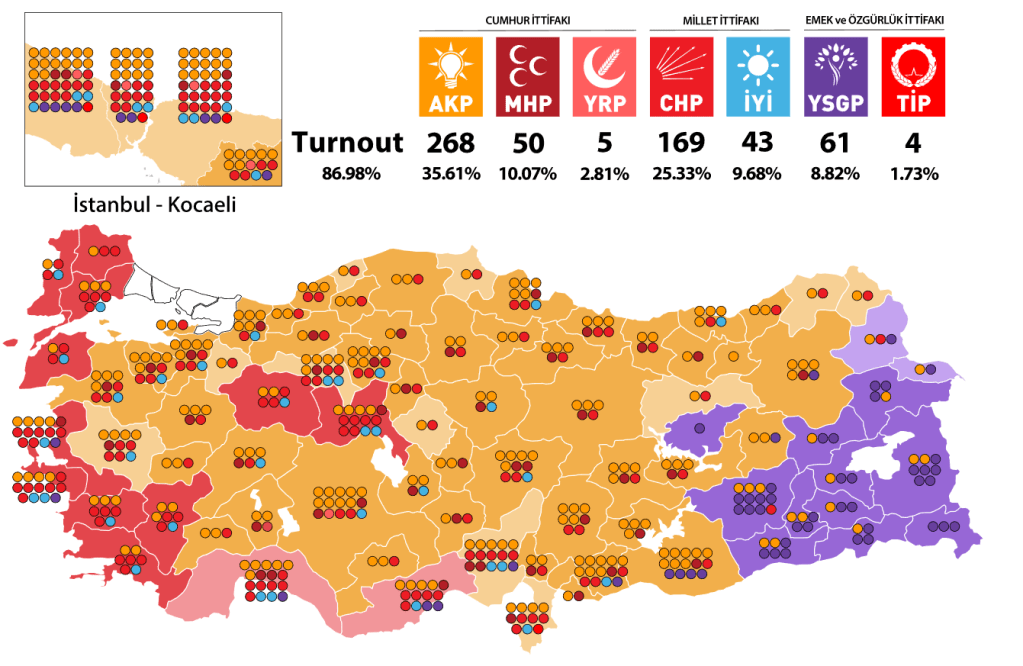
The elections were held simultaneously for the Turkish Grand National Assembly members and the presidency. Over 30 political parties participated in the parliamentary elections. However, in order for a party to enter the parliament in Türkiye, it needs to receive a minimum of 7% of the votes, otherwise, the votes of the party that fails to pass the threshold do not have an impact. As a solution to this, parties chose to form alliances.
- Cumhur İttifakı (People’s Alliance)
Led by Erdogan’s party, the Justice and Development Party (AKP), and the Nationalist Movement Party (MHP), this alliance mainly represents conservatives and political Islamists. Erdogan made a radical decision to include the Free Cause Party, an affiliate of the Hezbollah terrorist organization, in his alliance, which even caused reactions within his own base.
- Millet İttifakı (Nation Alliance)
Led by presidential candidate Kemal Kılıçdaroğlu, this alliance consists of the Republican People’s Party (CHP), founded by Ataturk, and the İYİ Party (center-right nationalist party). However, Kılıçdaroğlu formed the 6-Party Table formation by including four political Islamist (two former AKP members) parties, whose total votes did not even reach 2%, in the alliance. Many nationalists reacted negatively to the formation of this table. Except the İYİ Party, the other four parties entered the elections from CHP lists and tried to impose Kılıçdaroğlu as the President.

- ATA İttifakı (ATA Alliance)
Led by former MHP member Ümit Özdağ’s Victory Party (Zafer Partisi), this alliance brought the issue of illegal refugees and the immigration problem, which is one of Türkiye’s major problems, to the country’s agenda.
- And Others…
Labor and Freedom Alliance – An alliance formed by the Green Left Party (YSP), considered as the political arm of the PKK terrorist organization, and the Türkiye Worker’s Party. This alliance has high vote rates in the eastern and southeastern provinces of Türkiye.

Candidates
Recep Tayyip Erdogan – The leader of the AKP, who has been in power for 20 years, entered these elections in a period when he was significantly weaker. Due to Erdogan pressuring the Central Bank to lower interest rates, there was a high inflation and exchange rates, which gradually worsened the country’s economic crisis and led to a visible impoverishment of the people. Corruption scandals involving government members also caused a reaction among the public. Additionally, the inadequate and delayed handling of the major earthquake crisis in Türkiye on February 6, 2023, by the government resulted in Erdogan losing power.
Kemal Kılıçdaroğlu – Since 2010, Kılıçdaroğlu, the leader of the main opposition party, has lost a total of 11 elections against Erdogan. Despite all the criticisms, his decision to run as a candidate led to accusations that he was someone obsessed with power. Especially slogans such as the release of YSP leader Demirtaş from prison and his reconciling movement received strong backlash from the nationalist segment. However, all the polls conducted before the elections showed that if Mayor of Istanbul Ekrem İmamoğlu or Mayor of Ankara Mansur Yavaş were candidates, Erdogan would lose by a significant margin. Although Kılıçdaroğlu received a significant number of votes from the secularists in the western regions and the Kurdish voters in the eastern regions, he failed to gain support in Anatolia. In the last meeting of the six-party table, as a result of four parties forcing Kılıçdaroğlu to be a candidate, Meral Akşener, the leader of the İYİ Party, who had left the table, returned under the condition of becoming the deputy president of Ankara and Istanbul municipalities. Furthermore, the other five leaders at the table were also planned to be among the deputy presidents.
Sinan Oğan – Former Nationalist Movement Party (MHP) deputy Sinan Oğan, representing the nationalist and idealist segment, ran as a candidate and quickly gained sufficient attention in politics as a new figure. He achieved a good vote potential, especially becoming the presidential candidate for some Kemalist and nationalist voters who did not want to vote for Kılıçdaroğlu. He was also put forward as a candidate by the parties of the ATA Alliance at that time.
Muharrem İnce – In the 2018 presidential elections, Muharrem İnce, who ran against Erdoğan, received 30% of the votes. However, this was not enough for him to win the presidency. At that time, as a member of the CHP, İnce wanted to participate in the party’s general presidency elections since he received more votes individually than his own party. However, he failed to collect enough signatures for an extraordinary congress, and then he resigned from the CHP and became the founding leader of the Memleket Partisi(Homeland Party). The first surprise of the elections came when İnce withdrew from the presidential candidacy three days before the election. It was later revealed that İnce’s claims of being set up by a separatist organization were true. In his own words, he said, “I have been resisting for 45 days. I am withdrawing from the candidacy; I am doing this for my homeland. Let there be no more excuses. When they lost the election, they would blame us for everything on the morning of the election.”
1st Round
With the results announced on the evening of May 14th, Erdogan received 49.52% of the votes, Kılıçdaroğlu received 44.8%, and Oğan received 5% of the votes. This meant that the election would go to a second round between the two candidates with the highest votes. Because according to the current system, the presidential candidate needs to have 50% + 1 vote to be elected.
This shifted the focus to the second round of elections on May 28th. The result also shocked the leader of the main opposition, Kılıçdaroğlu, and the CHP, as they had no preparations for the second round in their campaign and planned to finish the election in the first round. However, Erdogan was more prepared for this situation.
New Alliances
The close vote percentages between Erdoğan and Kılıçdaroğlu leading to the second round made Oğan, the third candidate, a key figure. Sinan Oğan stated that he would hold talks with both sides in the following days after May 14th, making neutral statements. However, after meeting only with Erdoğan, he declared his support for Erdoğan without passing the baton to Kılıçdaroğlu. This announcement received strong backlash from the nationalists supporting Oğan and the ATA alliance. The leader of the ATA alliance, Ümit Özdağ, started to support Kemal Kılıçdaroğlu after signing a protocol with him, in which it was agreed that refugees would be sent back as soon as possible and that Kılıçdaroğlu’s government would remain loyal to the immutable articles of the constitution and the definition of Turkishness.
Changes in Parliamentary Seats
The Main Opposition Party entered the parliament with 169 deputies, but 37 of these deputies were from Kılıçdaroğlu’s 6-Party Table alliance, consisting of former AKP members and political Islamist parties. In addition, the AKP alone won 268 seats, and as an alliance, they secured 343 seats. It is known that Erdogan has plans to change the constitution, and for this, he needs 360 deputies in the parliament (with 360 deputies, the country can go to a referendum). The former AKP members who sided with Kılıçdaroğlu are potential individuals who have previously made statements about changing sides and may support Erdogan again in the future.
The Second Round
Türkiye woke up on the morning of May 28th, polarized and divided into two due to their beliefs. This time, the election was only between Erdoğan and Kılıçdaroğlu. While Erdoğan had the support of the People’s Alliance and Sinan Oğan, Kılıçdaroğlu was supported by the Nation Alliance and the ATA alliance. However, with the announcement of the initial results, a clear picture emerged. Erdoğan had 52.16% of the votes, while Kılıçdaroğlu had 47.84%. Erdoğan won a large part of Anatolia, while Kılıçdaroğlu received most of the votes in the western and southern coasts and a majority of the eastern provinces. The hopes of the people who wanted a change with a new leader were postponed until 2028. Calls for resignation to Kılıçdaroğlu, who lost the election for the 12th time, remained unanswered. Kılıçdaroğlu, in his own words, said, “As a person of these lands, I have been fighting so that I do not oppress you and will continue to fight.”

What is next?
Erdoğan, during his 20-year tenure, does not seem to be making significant changes to his policies in this additional 5-year period. However, the country’s international influence continues to be affected by domestic politics as time goes on.
Erdogan‘s harsh criticisms and words towards citizens who oppose him are leading to further polarization among the people. Particularly, the statements made by Interior Minister Süleyman Soylu to keep Syrians and transit refugees in the country are receiving backlash from a significant majority of the population. If Türkiye does not take necessary measures against the environment created by illegal immigrants and refugees, it will struggle to maintain its demographic balance in the coming years. Additionally, it is indicated that a large portion of young people in Türkiye do not see a bright future for themselves and express a desire to leave the country.

Regarding foreign relations, Erdoğan is expected to continue with the same policies. Türkiye will maintain its neutrality in the Russia-Ukraine conflict, uphold its commitment to NATO as one of its strongest allies, and try to improve its relations with the European Union to some extent. Türkiye will continue its fight against the YPG and PKK terrorist organizations in Syria and Northern Iraq, which pose a national security problem on its borders, and while attempting to establish new relations with Iran and Armenia in the east, it will prioritize Azerbaijan’s interests. In summary, Erdoğan will continue to adhere to state doctrines in foreign relations while simultaneously pursuing policies under the umbrella of Islamic solidarity with his own political Islamist identity.
Since coming to power, Erdoğan has made unprecedented statements that attribute inflation to interest rates and has operated with a weak economic theory in the background. He has conveyed the message that he will continue in the same vein. His intervention in the central bank and his policy of lowering interest rates before the elections had increased inflation and significantly affected foreign exchange rates. Citizens were complaining about the high cost of living. If the interest rate hikes continue, it does not seem likely that a brighter picture will see the light in the upcoming years.
Why did the opposition lose?
Kemal Kılıçdaroğlu, who has lost 11 elections, once again demonstrated that he is a power-hungry and unsuccessful strategist, stating that he became a candidate at the request of the four parties in his alliance called the “6-party Table.” In his attempts to secure the votes of Kurdish voters, he campaigned in a way that alienated the Anatolian population and nationalists, asking for their votes presumptuously, which backfired in the elections. Particularly within the Republican People’s Party (CHP), which he leads, party executives who do not adhere to Kemalist and nationalist ideology and make statements to the contrary have contributed to Kılıçdaroğlu ‘s misguided strategies.
Furthermore, many polls before the elections indicated that Kılıçdaroğlu would lose against Erdogan, but it was predicted that Istanbul and Ankara mayors, Mansur Yavaş and Ekrem İmamoğlu, would easily win these elections.
Although Kılıçdaroğlu tried to win over nationalist voters by changing his election tactics for the second round, his statement calling for the release of Selahattin Demirtaş, the leader of the Green Left Party, and his call for reconciliation had a significant backlash from the nationalist segment. Kılıçdaroğlu failed to have the desired impact on the nationalist segment during the two-week period between the two elections, making him destined to lose his 12th election.
The assessment of the mistakes made will be seen in the coming days, but it has never been observed in Türkiye for political leaders who lose elections to resign. The opposition must analyze why they failed to reach the people sufficiently and learn valuable lessons from their mistakes; otherwise, Kılıçdaroğlu may face his thirteenth loss in 2028.
While the situation in Türkiye may not seem very promising for both the ruling party and the opposition, Türkiye, which has the youngest population in Europe and one of NATO’s strongest armies, continues to hold great potential.
As Mustafa Kemal Atatürk once said, ” There are no hopeless situations, there are hopeless people. I have never lost hope.”
A cura di Semih TOPALOĞLU
 The Journal