
The matter of abortion is a heavily controversial topic nowadays, as more and more organizations and liberal groups rise in favor of its banning or on the other hand, in favor of its promotion and raising awareness on the topic.

In most cases, abortion is a complex matter to handle at the government level, as it is interpretable in different ways. In communities where religion is a life-defining element, abortion can easily stem down to murder and can only be considered an option if the fetus shows signs of congenital disorders or if the mother shows signs of illness related to childbirth, such as preeclampsia.
Other communities focus their attention more on the postpartum period, taking into consideration the parent’s ability to maintain the child, whether it be financially or emotionally. This more narrowly refers to cases of poverty, rape, or in more extreme cases, even incestual rape.
Nowadays, many societies are actively divided on the topic of abortion, and simultaneously, more and more pressure builds on the international scale for the promotion and defense of women’s rights.
Controversial about abortion
No matter what the different societies’ stances are on the topic, abortion is a subject which most societies are heavily divided on, as more and more pressure builds on the international scale to take a stronger stance on women’s rights. Still, to ascertain that a universal response to this dilemma exists would be wrong, as abortion is an extremely heavy reality with massive societal and political impact in its hands.
In what manner can liberal countries judge nonsecular countries for dismissing external influence on their beliefs and principles?
In societies where religion plays a more fundamental role in political or moral decision-making, abortion is explicitly considered murder, leading women who have illegal abortions to be liable to be tried judicially or receive the death penalty depending on the country they’re in. Theocracies, for example, will generally not allow abortion to be a topic of discussion and no theocracy has had an abortion law that has lasted more than a month or so, citing Iran’s Therapeutic Abortion Act of 2005.
On the other hand, while some democracies don’t have any form of norm explicitly allowing abortion, democracies do entertain discussions on whether to norm abortion or to keep certain political entities serene. That is, democratic countries allow pro-abortion and pro-natalists to democratically discuss potential outcomes, favorable or unfavorable, of inserting abortion into law.
For this very reason, abortion tends to flourish in the West and is eradicated in the eastern and southeastern regions of the globe.
In Europe, Thirty-nine countries have legalized abortion on request. Two countries have legalized abortion on broad social grounds. Six countries do not allow abortion on either of these grounds. Among the countries that haven’t conceded the right to abort to women, are Poland and the smaller jurisdictions of Monaco, Liechtenstein, Malta, and the Faroe Islands, and abortion is prohibited in Andorra.
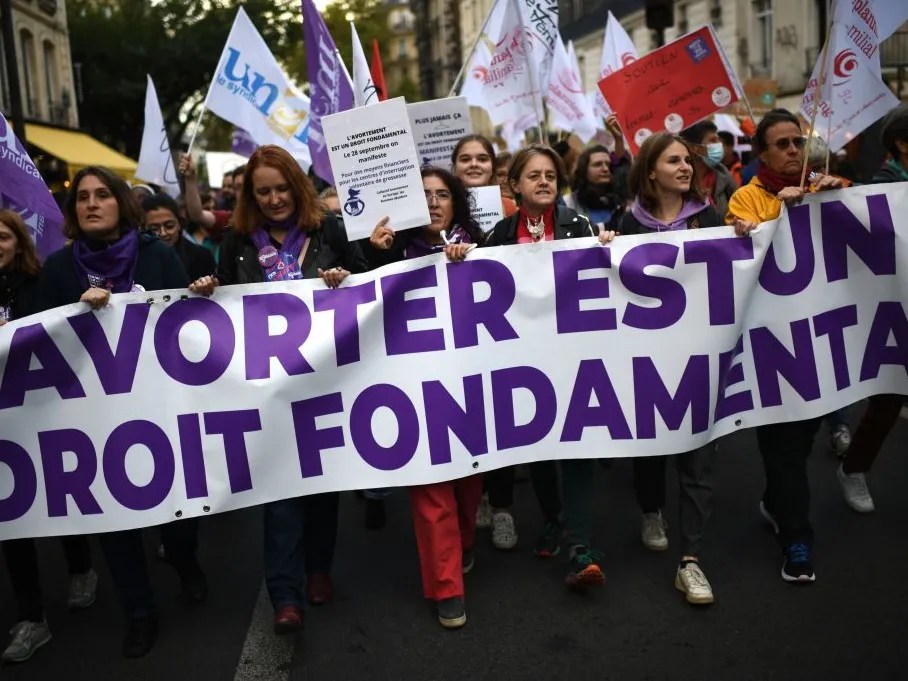
Most recently, France made a crucial first step towards helping women undergoing legal abortions in a safe and protected environment. Whereas a mere law can be repealed, a constitutional law must go through a more complex procedure to be repealed or amended. On this very note, abortion is now a constitutionally guaranteed right for all French women, making France the only and first country in the world to guarantee this right on a constitutional level. France already had an abortion law since 1975, called “Loi Veil” named after its pioneer, Simone Veil, who was at the time the minister of public health in France. That law ceased to criminalize abortion for its five-year lifetime, but then in 1979, once it was time to either repeal it or renew it, it was decided that the law should be renewed, this time without a time limit.
The Veil law’s
The Veil law’s primary function was to decriminalize voluntary termination of pregnancy before the end of the tenth week of gestation, with conditions such as:
- situation of distress;
- pregnancy of equal to or less than 10 weeks
- intervention performed by a doctor in a hospital setting;
- mandatory information and reflection procedures: two medical consultations (with a delay for reflection between the two) in which the risks and alternatives are presented by the doctors, and a psycho-social consultation;
- consent confirmed in writing;
- doctors and other health care personnel are covered by a conscience clause, such that no one is required to terminate a pregnancy if they hold ethical objections.
The law also legalized voluntary termination of pregnancy for therapeutic reasons, which could be practiced under certain conditions:
- Serious danger to the health of the parent or strong probability that the unborn child would suffer from a particularly serious condition recognized as incurable at the time of diagnosis, as attested by two doctors;
- no delay, and performable until the last day of the pregnancy;
- intervention performed by a doctor in a hospital setting;
- doctors and other health care personnel are covered by a conscience clause, such that no one is required to terminate a pregnancy if they hold ethical objections.

Constitutionalizing this law aims to establish a safeguard against attacks on abortion access and sexual and reproductive health rights around the world. President Emmanuel Macron took this initiative after the US Supreme Court overturned Roe v. Wade, which had federalized the freedom to have an abortion as part of the right to privacy.
Despite the importance of this big step, establishing a norm does not imply that norms will be interpreted. On a topic such as abortion, interpreting the law can sometimes be harder than just simply luring doctors into performing these operations. In a country such as France, where for many, accessing some public institutions can be impossible due to the establishments being unevenly scattered over the territory. Interpreting this kind of law means that the government must edify specific establishments, such as ‘planned parenthood’, transplant gynecologists who are willing to perform this operation, or edify fully-abortion dedicated centers. The inequality of territory is perhaps a stronger enemy of women needing the operation, than governments.
A cura di Costanza Santillo
Fonti:
 The Journal