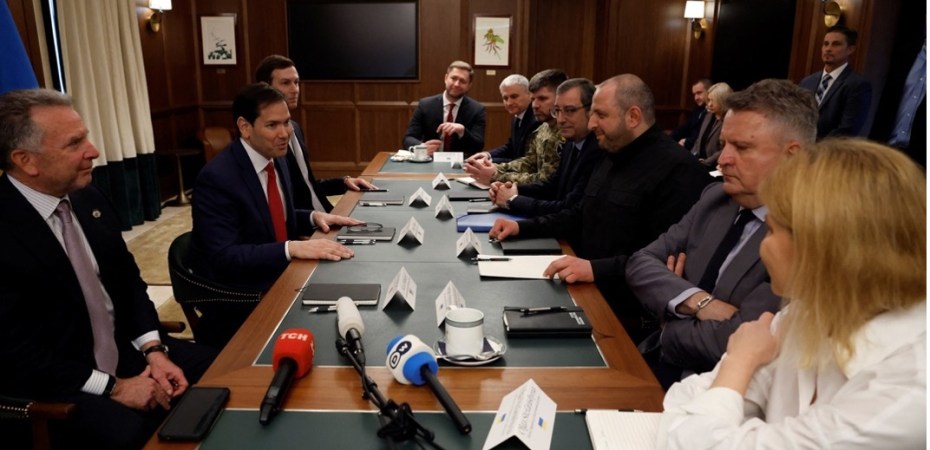
On November 19th, 2025, the United States government proposed publicly to Volodymyr Zelenskyy, Ukrainian president, a 28-point peace plan to end the Russia-Ukraine war. Titled “Ukraine Peace and Reintegration Accord”, it mostly aims at establishing peace and define future territorial arrangements. This plan was developed by Trump’s son in law Jared Kushner, the Russian Diplomat Kirill Dmitriev, and Ukraine’s chief of national security.
According to the draft, Ukraine’s sovereignty would be confirmed, and a non-aggression agreement would be signed between the two parties, with Russia committing to enshrine in law this antimilitaristic policy. Also, Ukraine be a non-nuclear state and will not join NATO, but will still receive security guarantees, unless if it invades or launches attacks towards Russia.
Moreover, this proposal further restricted Ukrainian army to no more than 600.000 military personnel.
The US will cooperate to modernize and contribute to reconstruct Ukraine’s economy, with also the investment of 100 billion dollars in frozen Russian assets. On the other end, Russia will be reintegrated into the global economy and invited to join the G8.
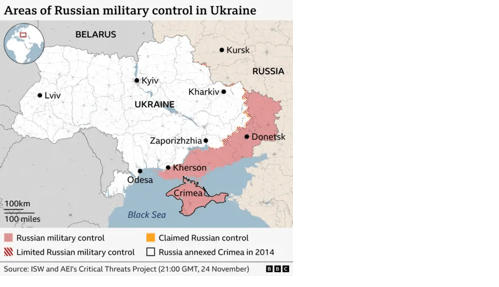
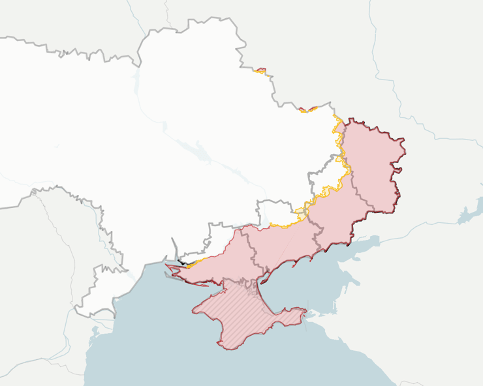
Regarding the territorial disputes, both countries are undertaking not to change any territorial arrangement on which they agree on: these would include the Russian withdrawal outside the five regions of Donetsk, Luhansk, Zaporizhzhia, Kherson, and Crimea, that would be recognized as de facto Russian.
The border issue is definitely the most discussed, with Zelensky openly criticizing Putin’s demand for legal recognition of territories he stole from Ukraine, accusing him of “violating the principle of territorial integrity and sovereignty.”
Ukraine’s European allies also sided against the deal: the UK, Germany and France released an alternative peace plan that allowed Ukraine to join NATO. The European Commission President Von Der Leyen stated: “Any credible and sustainable peace plan should first and foremost stop the killing and end the war, while not sowing the seeds for a future conflict”, accusing Russia of not having a real intent in bringing actual peace. Additionally, she made very clear that “Europe will stand and support Ukraine in every step of the way”.
Ukraine continues to burden heavy losses under Russian bombardment, and many reject the idea of what seems like a surrender, after almost four years of war. In fact, on Monday, Zelensky admitted that the main problem keeping the two countries from peace was Putin’s demand for legal recognition of the seized territories, whose concessions would require a referendum to be legally allowed. At the same time, Moscow keeps demanding full Ukrainian withdrawal from the Donbas region.
This past week a new peace plan emerged, with what it seems like a compromise: the US are willing to remove the 600.000 limit to Ukraine’s army, and some changes about the restrictions on NATO troops positioned in Ukraine. Even though the US delegation’s main goal was to review all the issues raised by the Ukrainian side, with no Russian representative at the table there are no guarantees that Putin will accept this deal.
It is important to remember the Russian declared annexation of the Donetsk, Kherson, Luhansk, and Zaporizhia, that Moscow does not want to give up. Also, it has vehemently objected to Ukraine’s potential enter in the NATO membership.
On late Friday afternoon (Nov. 28th), Ukrainian naval drones hit two Russian oil tankers just outside Turkish Black Sea. Crew members from both vessels were reported to be safe, but this attack appears to be an escalation to hit Russia’s oil revenues, fundamental for funding war in Ukraine. The attacks can also be seen as a warning, suggesting that ships carrying Russian oil face the risk of direct attack, not just Western sanctions.
Even though on Monday (Dec. 1st) Witkoff and Putin met in a closed-door meeting in preparation for Russian American deals, there is little hope that Putin will agree to a deal: it seems like the leader will not compromise, and considers negotiation with the Ukrainian president to be pointless. He also believes in the progress made by the Kremlin on the battlefield and wants to wait till Kyiv complies to his demands.
Unless a decisive change alters the balance of incentives, the war seems destined to keep going, leaving the future of any peace accord dependent on shifts that none of the factions are apparently willing to make. Like the US secretary of State, Marco Rubio, said: “I think there is a shared vision here that this is not just about ending the war, which is very important; it is about securing Ukraine’s future, a future that we hope will be more prosperous than it’s ever been.”
A cura di Chiara Pinna
Fonti:
https://www.theguardian.com/commentisfree/2025/nov/28/28-point-peace-plan-ukraine-trump-putin
 The Journal