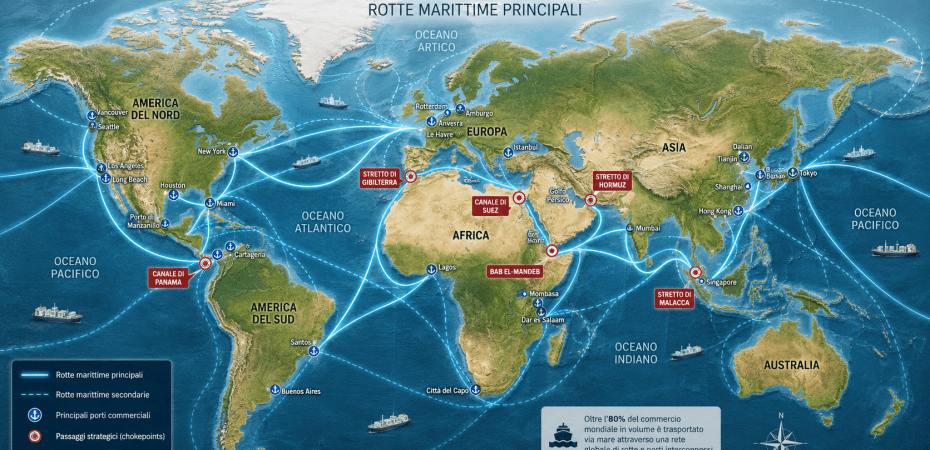
For centuries, empires understood a simple truth: whoever controlled the sea controlled trade, and whoever controlled trade controlled wealth. The Romans knew it in the Mediterranean; the British Empire built a global order around it. Today’s global economy has not escaped the same logic. When tensions rose around the Strait of Hormuz, markets reacted almost instantly — energy prices fluctuated, freight costs increased, insurance premiums spiked, and inflation concerns resurfaced across interconnected economies. The reason, argues Dr Luigi Capoani, founder and researcher of the European Youth Think Tank (EYTT), is hiding in plain sight: despite decades of globalisation, the world’s prosperity still flows through a handful of narrow passages. The Journal ASP sat down with him to understand why.
Globalisation was supposed to make the world borderless. So why do a few narrow straits still have the power to shake global markets?
The premise of globalisation was that distance was becoming irrelevant — that trade liberalisation and digital connectivity were flattening the world into a frictionless network. What that story overlooked was the physical infrastructure underneath. Goods still move by ship, and ships still move through specific corridors. According to UNCTAD’s Review of Maritime Transport (2024), over 80% of global trade by volume is carried by sea. Concentrate that volume through a handful of narrow straits, and you get extraordinary fragility. Geography never disappeared — it became concentrated. Chokepoints like Hormuz, Suez, Malacca and Panama are not strategically important because of their size. They matter because they concentrate flows. Globalisation has created highly integrated networks connecting producers, consumers and financial markets — and when a limited number of corridors are disrupted, the repercussions travel across the entire system. The blockage of the Suez Canal in 2021 made this visible: a single ship, stuck for six days, cascaded into supply-chain disruptions felt worldwide.
Let’s focus on Hormuz specifically. What makes it the most critical of these passages?
The numbers alone are striking. In 2024–2025, it accounted for over 25% of global seaborne oil trade and 20% of global LNG supply (EIA, 2025). However, its true significance lies beyond mere volume. The Strait functions as the convergence point for four distinct levers of global power: energy, trade, finance, and monetary influence.
Can you walk us through those four levers?
The first is energy, and it is the most direct. Close Hormuz, and production costs climb across every sector that depends on oil and gas — which is to say, nearly every sector. The second lever is trade more broadly: disruptions translate into longer rerouting, higher freight costs and soaring insurance premiums, all of which feed through supply chains and eventually surface as inflation. The third lever is finance, and this is where things get subtler. Commodity markets respond to expectations, not just events. Long before a tanker is physically blocked, futures markets price in the possibility of future disruption. Investors, insurers and shipping companies adjust their behaviour immediately, generating volatility across energy and financial markets before any shortage materialises. The fourth lever — monetary power — is the most underappreciated. Since the 1970s, a large share of international oil transactions has been denominated in US dollars through what is known as the petrodollar system. As Eichengreen documents in Exorbitant Privilege (Oxford University Press, 2012), this arrangement has significantly reinforced the international role of the dollar and, more broadly, American influence within the global financial architecture. While the dollar remains overwhelmingly dominant, countries such as Iran and Russia have increasingly explored alternative payment mechanisms and currencies for part of their energy exports. Discussions around Hormuz are therefore never purely about energy security — they also touch on broader questions about the future of the international monetary system.
So when tensions rise around a chokepoint, how rapidly do the economic consequences manifest?
Almost immediately — and this is the crucial mechanism. Geopolitical instability affects economies not only through actual disruptions but through expectations. When uncertainty increases around a strategic corridor, market participants adjust their behaviour long before any physical interruption occurs. Inflationary pressures and rising costs often emerge before shortages materialise, because economic actors respond to the possibility of future disruptions, not just to the disruptions themselves. This is why geopolitical crises so frequently generate consequences that appear disproportionate to what is actually happening on the ground. In a highly interconnected economy, uncertainty itself becomes a source of economic cost. It is not irrational panic — it is rational pricing of plausible futures.
Your research at EYTT also challenges how economists model trade. What is missing from conventional analysis?
The gravity model is one of the most widely used frameworks for analysing international trade, and it works well — but most gravity-based studies still rely on traditional geographic distances between countries. The problem is that sea routes are not straight lines between capitals. They thread through specific corridors where chokepoints create asymmetric vulnerabilities that standard models fail to capture. Studies published in Conflict Resolution Quarterly article and Defence & Peace Economics article by EYTT researchers indicate that distance continues to shape economic flows in ways conventional models tend to understate. And yet relatively little academic work has incorporated maritime distances and the role of strategic passages into trade analysis — despite the fact that, as UNCTAD’s data confirms, over 80% of world trade moves by sea. Understanding how these corridors influence trade costs, resilience and economic vulnerability is an important frontier for future research, and one that is becoming more urgent as supply-chain fragility moves to the centre of the geopolitical agenda.
What is the broader lesson here — for how we understand power in the twenty-first century?
Geopolitical crises should not be read solely through military or diplomatic lenses. They redistribute costs, opportunities and competitive advantages across countries and sectors. This does not mean every conflict is engineered to achieve economic ends — such claims are rarely demonstrable. But instability does produce winners and losers, and understanding who benefits and who bears the costs is increasingly central to any serious analysis of international affairs. The study of chokepoints ultimately reveals something fundamental: in the twenty-first century, power is exercised not only through control of territory, but through the ability to influence the flows that connect the global economy. The old empires understood that whoever held the sea lanes held the world’s wealth. The logic endures — only the geography has grown more precise.
By Paola Emilia Castelli
About:
Luigi Capoani is an economist, researcher, and lecturer in International Economics at Ca’ Foscari University of Venice. He earned his PhD in Economics from the University of Salerno through an international cotutelle programme with the University of Birmingham. He is the Founder and President of the European Youth Think Tank (EYTT), a non-profit and independent platform connecting young European researchers and promoting interdisciplinary projects aimed at international scientific publication. Within EYTT, he coordinates interdisciplinary research activities and the development of scientific projects focused on innovation and international collaboration among early-career scholars.
Paola Emilia Castelli is an Analyst at the European Youth Think Tank (EYTT), where she contributes to research and policy analysis on European affairs, international politics, and public policy. She is also a journalist for The Journal ASP, where her work concentrates on geopolitics. Her research interests include European integration, energy and climate policy, social inequalities, and international governance, with a particular focus on the political and socioeconomic challenges facing contemporary Europe.
 The Journal